
Among the many technologies available today, .NET and WordPress are two of the most widely adopted platforms, but they serve different purposes. WordPress has become the world’s most popular content management system (CMS), powering millions of websites because of its simplicity and extensive ecosystem. On the other hand, Microsoft’s .NET platform is recognized for building secure, scalable, and highly customized web applications that support complex business operations.
Businesses often ask, “Which platform is better?” The honest answer is that there is no universal winner. The right choice depends entirely on your organization’s goals, technical requirements, growth plans, budget, and operational needs.
This article explores both platforms from a neutral perspective, comparing their strengths, limitations, and ideal use cases to help businesses make informed decisions.
Understanding WordPress
WordPress began as a blogging platform but has evolved into a comprehensive content management system capable of powering websites ranging from personal blogs to corporate websites and online stores.
One of the biggest reasons behind WordPress’s popularity is its ease of use. Users with little or no programming knowledge can publish content, update pages, install themes, and add functionality through plugins.
Today, WordPress supports thousands of themes and plugins that allow businesses to extend functionality without building everything from scratch.
Typical WordPress Use Cases
- Company websites
- Blogs
- Portfolio websites
- Small to medium eCommerce stores
- Educational websites
- News portals
- Landing pages
- Event websites
Its flexibility and ease of deployment make it particularly attractive for organizations seeking a quick online presence.
Understanding .NET
.NET is Microsoft’s software development framework for building modern web applications, enterprise systems, APIs, cloud-native solutions, desktop applications, and mobile applications.
Unlike WordPress, .NET is not a content management system. It is a complete development platform that enables software engineers to build fully customized solutions according to business requirements.
Modern .NET development commonly utilizes technologies such as:
- ASP.NET Core
- C#
- SQL Server
- REST APIs
- Microsoft Azure
- Angular
- React
A common enterprise architecture involves:
- Backend developed using ASP.NET Core
- Frontend developed using Angular or React
- SQL Server as the relational database
- IIS (Internet Information Services) for hosting web applications
This architecture provides flexibility, performance, and long-term scalability suitable for businesses that require customized workflows and advanced integrations.
Core Difference Between .NET and WordPress
Although they can both produce websites, they are fundamentally different.
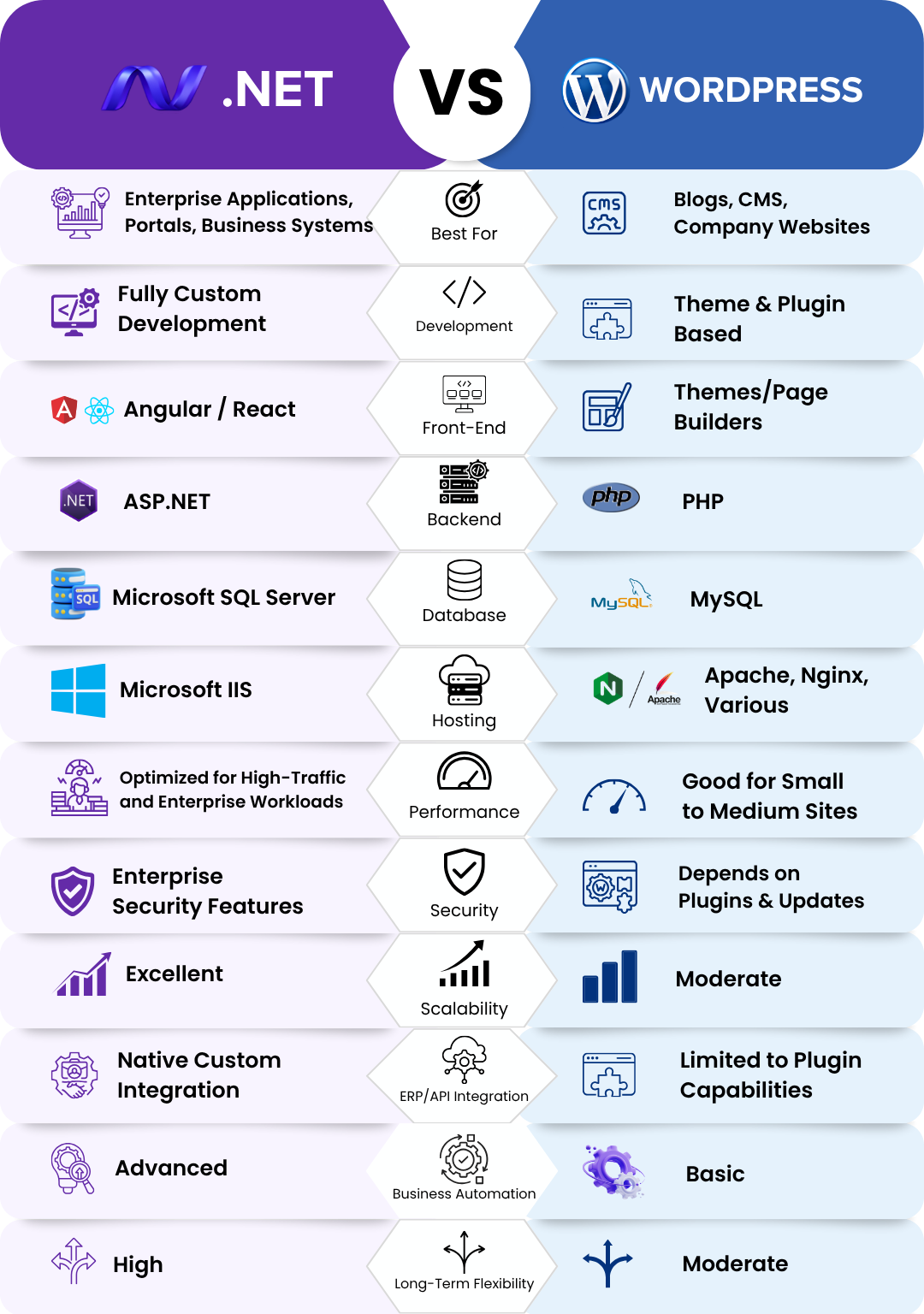
Comprehensive Comparison: .NET vs WordPress
| Feature | WordPress | .NET |
|---|---|---|
| Primary Purpose | A Content Management System (CMS) designed for websites, blogs, and content publishing. | A software development framework used to build custom websites, enterprise applications, APIs, portals, and business systems. |
| Ease of Development | Faster to launch using ready-made themes and plugins. Suitable for standard website requirements with minimal coding. | Requires software development from the ground up, resulting in applications tailored specifically to business requirements. |
| Development Flexibility | Flexible within the capabilities of themes and plugins. Extensive customization often requires PHP development. | Offers virtually unlimited customization. Every feature, workflow, and integration can be designed according to business needs. |
| Performance | Performance depends on hosting quality, caching, theme optimization, plugin selection, and database maintenance. | High-performance framework with compiled code, efficient memory management, advanced caching, and excellent handling of concurrent users. |
| Security | Secure when regularly updated, but third-party plugins and outdated themes can introduce vulnerabilities if not maintained properly. | Provides enterprise-grade security capabilities including authentication, authorization, encryption, secure APIs, and role-based access control. |
| Scalability | Well suited for content-heavy websites and moderate business growth when properly optimized. | Designed for large-scale enterprise applications that can grow with increasing users, services, and business operations. |
| Database Support | Commonly uses MySQL or MariaDB, which are suitable for most website requirements. | Frequently uses Microsoft SQL Server, offering advanced transaction management, reporting, backup, and enterprise-level reliability. |
| Frontend Development | Typically uses server-rendered PHP themes, although modern JavaScript frameworks can also be integrated. | Frequently paired with Angular or React to create responsive, interactive, single-page applications through REST APIs. |
| Hosting Environment | Can be hosted on shared hosting, VPS, cloud platforms, or managed WordPress hosting, most commonly on Linux servers. | Commonly hosted on Windows Server using IIS, cloud platforms such as Azure, or dedicated enterprise infrastructure. |
| Maintenance | Requires frequent updates for WordPress core, themes, plugins, backups, and security monitoring. | Maintenance focuses on application enhancements, framework updates, server monitoring, database optimization, and performance improvements. |
| Third-Party Extensions | Thousands of plugins are available for adding functionality quickly. Plugin quality and compatibility should be evaluated carefully. | Integrations are typically developed through APIs, custom libraries, or enterprise services rather than relying on marketplace plugins. |
| Content Management | Excellent built-in content management capabilities with an intuitive interface for non-technical users. | Content management features are custom-developed or integrated through dedicated CMS solutions when required. |
| Integration Capabilities | Supports integration with many popular services through plugins, though complex enterprise integrations may require custom development. | Designed to integrate with ERP systems, CRMs, payment gateways, cloud services, identity providers, and virtually any API-based platform. |
| Typical Development Time | Usually shorter due to pre-built themes and plugins that accelerate implementation. | Generally longer because every component is designed and developed according to project requirements. |
| Cost | Lower initial development costs for standard websites, though premium themes, plugins, and ongoing maintenance should be considered. | Higher initial investment due to custom development, but often delivers greater flexibility and long-term scalability. |
| Ideal For | Corporate websites, blogs, portfolios, marketing websites, educational websites, news portals, and small to medium online stores. | Enterprise software, customer portals, ERP systems, CRM platforms, healthcare applications, financial systems, government portals, and large-scale business applications. |
Can Both Platforms Work Together?
Yes, Many organizations successfully combine the strengths of both technologies.
For example:
- WordPress manages marketing content and blogs.
- A .NET application powers customer portals.
- ASP.NET APIs communicate with mobile applications.
- SQL Server stores operational business data.
- Frontend applications built using Angular or React provide interactive user experiences.
- IIS hosts enterprise applications while the website operates independently.
This hybrid approach allows businesses to use each platform where it performs best.
Final Thoughts
The comparison between .NET and WordPress should not be viewed as a competition with a single winner. Each platform was created to solve different business challenges.
WordPress excels at delivering content efficiently, enabling organizations to launch and manage websites with minimal technical complexity. It remains an excellent option for businesses focused on publishing information, engaging audiences, or establishing a professional online presence quickly.
.NET, in contrast, provides a powerful foundation for organizations that require tailored software solutions, advanced integrations, secure environments, and applications capable of supporting complex business processes. With technologies such as ASP.NET Core, Angular, React, SQL Server, and IIS, businesses can build scalable systems that evolve alongside organizational growth.
Ultimately, the most effective platform is the one that aligns with your business objectives, technical requirements, available resources, and long-term digital strategy. Rather than asking which platform is universally better, organizations should evaluate which solution best supports the outcomes they hope to achieve today, and the flexibility they may need tomorrow.